
Islamic Prayer Times | IbadahApp
Islamic Namaz Time in Mecca
18 September (Fri)
7 Rabi' al-Thani · Today
- Fajr4:54 AM
- Dhuhr12:16 PM
- Asr3:39 PM
- Maghrib6:21 PM
- Isha7:31 PM


سُبْحَانَكَ اللَّهُمَّ وَبِحَمْدِكَ
Subhanakal-lahumma wa bihamdika
Glory be to You, O Allah, and all praise.
September Prayer Timetable for Mecca
IbadahApp lets you save the monthly namaz timetable to stay organized in your daily prayers. You can also share the timetable with family and friends.
| Sep. | Day | Fajr | Dhuhr | Asr | Maghrib | Isha |
|---|---|---|---|---|---|---|
| 1 | Tue | 04:48 | 12:22 | 15:45 | 18:37 | 19:48 |
| 2 | Wed | 04:49 | 12:21 | 15:45 | 18:36 | 19:47 |
| 3 | Thu | 04:49 | 12:21 | 15:45 | 18:35 | 19:46 |
| 4 | Fri | 04:49 | 12:21 | 15:44 | 18:34 | 19:45 |
| 5 | Sat | 04:50 | 12:20 | 15:44 | 18:33 | 19:44 |
| 6 | Sun | 04:50 | 12:20 | 15:44 | 18:32 | 19:43 |
| 7 | Mon | 04:51 | 12:20 | 15:43 | 18:32 | 19:42 |
| 8 | Tue | 04:51 | 12:19 | 15:43 | 18:31 | 19:41 |
| 9 | Wed | 04:51 | 12:19 | 15:43 | 18:30 | 19:40 |
| 10 | Thu | 04:52 | 12:19 | 15:43 | 18:29 | 19:39 |
| 11 | Fri | 04:52 | 12:18 | 15:42 | 18:28 | 19:38 |
| 12 | Sat | 04:52 | 12:18 | 15:42 | 18:27 | 19:37 |
| 13 | Sun | 04:53 | 12:18 | 15:41 | 18:26 | 19:36 |
| 14 | Mon | 04:53 | 12:17 | 15:41 | 18:25 | 19:35 |
| 15 | Tue | 04:53 | 12:17 | 15:41 | 18:24 | 19:34 |
| 16 | Wed | 04:54 | 12:17 | 15:40 | 18:23 | 19:33 |
| 17 | Thu | 04:54 | 12:16 | 15:40 | 18:22 | 19:32 |
| Today | Fri | 04:54 | 12:16 | 15:39 | 18:21 | 19:31 |
| 19 | Sat | 04:55 | 12:16 | 15:39 | 18:20 | 19:30 |
| 20 | Sun | 04:55 | 12:15 | 15:39 | 18:19 | 19:29 |
| 21 | Mon | 04:55 | 12:15 | 15:38 | 18:18 | 19:28 |
| 22 | Tue | 04:55 | 12:14 | 15:38 | 18:17 | 19:27 |
| 23 | Wed | 04:56 | 12:14 | 15:37 | 18:16 | 19:26 |
| 24 | Thu | 04:56 | 12:14 | 15:37 | 18:15 | 19:25 |
| 25 | Fri | 04:56 | 12:13 | 15:36 | 18:14 | 19:24 |
| 26 | Sat | 04:57 | 12:13 | 15:36 | 18:13 | 19:23 |
| 27 | Sun | 04:57 | 12:13 | 15:35 | 18:12 | 19:22 |
| 28 | Mon | 04:57 | 12:12 | 15:35 | 18:11 | 19:21 |
| 29 | Tue | 04:57 | 12:12 | 15:34 | 18:10 | 19:20 |
| 30 | Wed | 04:58 | 12:12 | 15:34 | 18:10 | 19:19 |
IbadahApp: Your Daily Ibadah Tools for Prayer Times and Qibla
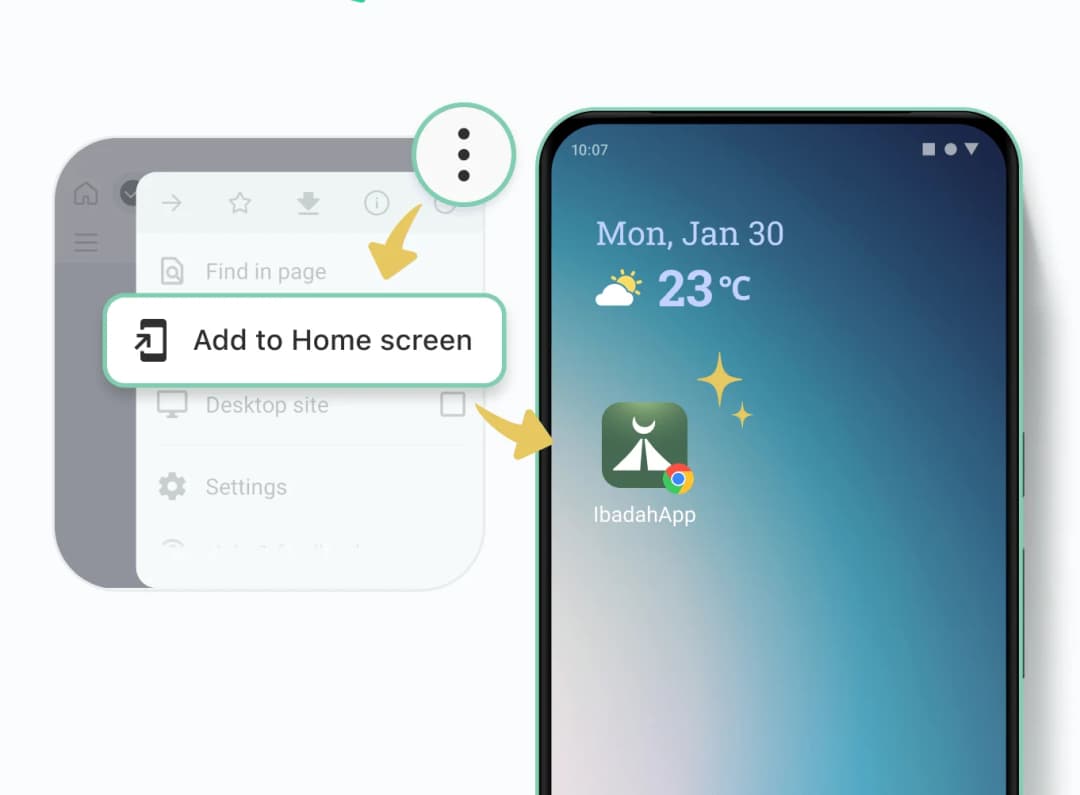
Why add it: One tap on your home screen opens today's prayer times and Qibla direction. No typing the address, no hunting for the tab.
How to add it: Open your browser menu and choose Add to Home Screen. The icon appears with your other apps.
Note: This adds a shortcut, not an app. Nothing is downloaded and no storage is used.
Muslim Prayer Times: When Each of the Five Prayers Falls
The five daily prayers are not spread evenly through the day. Each one opens at a point the sun reaches and closes when the next one opens, which is why the times move a little every day.
Fajr
Fajr opens at true dawn, when the first light shows, and closes at sunrise. Sunrise is the deadline: a Fajr prayed after it is a missed prayer being made up, not Fajr on time.
Dhuhr / Zuhr
Dhuhr opens once the sun has passed its highest point and begins to decline. Dhuhr and Zuhr are two spellings of the same prayer.
Asr
Asr opens in the afternoon, judged by how long an object's shadow has grown. This is the one prayer where the school you follow changes the time, explained further down.
Maghrib / Magrib
Maghrib opens the moment the sun has fully set, which is why Maghrib and sunset are the same moment. It closes when Isha opens.
Isha / Esha
Isha opens once the evening twilight has gone and the sky is dark. How dark counts as dark differs between methods, which is why Isha varies more between sites than the other four.
The Adhan, the Iqamah and the Prayer Time
The athan, also written azan or adhan, is the call announcing that a prayer time has opened. The iqamah is the shorter second call, given right before the congregation stands up to pray.
Mosques usually leave a gap between the two, often ten to twenty minutes, so people have time to arrive. That gap is one reason the time on IbadahApp and the time your mosque starts are not identical.
Why One Site Says 3:39 PM and Another Says 4:38 PM
Four things move the numbers.
The Sun Angle in the Method
Fajr and Isha are set by how far the sun sits below the horizon, and different bodies use different angles. A few degrees is several minutes on the clock.
The School, Which Only Affects Asr
IbadahApp supports both schools: Shafi'i and Maliki mark Asr when an object's shadow equals its own length; Hanafi waits until the shadow is twice that. The gap runs roughly 40 to 90 minutes depending on latitude and season. The other four prayers are not affected by this setting.
Where Your Device Thinks You Are
IbadahApp works out times from your coordinates. If your browser places you in the wrong part of town, or the wrong town, the times move with it.
What Your Mosque Decides
On top of what IbadahApp calculates, mosques set their own iqamah and often add a few minutes as a margin. Two mosques on the same street can start at different times.
How the Salah Time Method Gets Picked for Your Country
IbadahApp sets a default for your country rather than asking you to pick one.
In these countries IbadahApp defaults to the method the country uses officially:
- Saudi Arabia: Umm al-Qura
- Egypt: Egyptian General Authority of Survey
- Pakistan, India and Bangladesh: University of Islamic Sciences in Karachi
In these countries IbadahApp defaults to the closest available method to what the national authority publishes:
- Türkiye (authority: Diyanet)
- Malaysia (authority: JAKIM)
- Indonesia (authority: Kemenag)
The method IbadahApp uses is printed under the times, and Change lets you switch it.
If Your Mosque's Time Is Different
Follow your mosque for congregation; that is what the community prays behind. For prayers on your own, a few minutes after the listed time is the safer side. You can also switch IbadahApp to whichever method your mosque uses.
Prayer Time Today: Best, Still Valid, or Not on Time
Every prayer has a namaz start and end time: the window runs from when it opens until the next prayer opens. Where you pray inside that window changes what it counts as.
- Best: early in the window, not left until it is nearly over.
- Still valid: any time later in the window, up to the moment the next prayer opens.
- Not on time: after the window has closed. What you pray then is a missed prayer being made up, not the prayer at its time.
Praying early is the general principle, with exceptions. In strong heat most schools hold Dhuhr is better delayed until it cools, as many mosques do in summer. Some hold Isha is better delayed into the first third of the night. Ask your imam which applies.
Three moments are set aside from voluntary prayers, and all three fall in the gaps between windows:
- While the sun is rising: the Fajr window has closed, and you wait until the sun is clear of the horizon.
- While the sun stands overhead at midday: just before Dhuhr opens.
- While the sun is setting: just before Maghrib opens.
Obligatory prayers are not held back by this, and Maghrib begins at the moment the sun has fully set.
Muslim Namaz Time: The Voluntary Prayers, Their Windows and Their Reward
Beyond the five obligatory prayers there are voluntary ones, each with its own window and its own reported reward. IbadahApp lists the five obligatory times; the windows below are explained rather than shown as clock times.
Ishraq
Ishraq is prayed shortly after sunrise, once the sun has risen clear of the horizon.
A well-known hadith in Jami' at-Tirmidhi describes the reward for praying Fajr in congregation, staying seated in remembrance until sunrise, then praying two rakats: the reward of a complete Hajj and Umrah. The conditions are part of it, not just the two rakats.
Duha
Duha runs from mid-morning until just before Dhuhr opens.
A hadith in Sahih Muslim states that a charity is due each morning for every joint in the body, and that two rakats at Duha cover all of it. It is also called salat al-awwabin, the prayer of those who turn back to Allah.
Tahajjud
Tahajjud is prayed in the later part of the night, after sleeping and before Fajr.
The Qur'an addresses it directly in 17:79, and a hadith in Sahih Muslim names the night prayer as the best prayer after the obligatory ones. The last third of the night is the most encouraged part of the window.
Making Up a Prayer You Missed
Missing a prayer does not mean it is gone. It is still owed: that is qada, the make-up prayer. If you slept through it or forgot, praying it when you remember is what makes it up, with nothing extra owed. Letting the time pass on purpose is different.
What making it up looks like:
- Pray it when you remember, without waiting for the next prayer time.
- A make-up prayer does not stand in for the next prayer due. Pray the make-up, then pray the current one when its time comes.
- If more than one is owed, work back through them in the order they were due. (Schools differ on whether that order is required.)
If what you owe is more than a day or two, or you have lost count, the size is no reason to keep putting it off. A workable start: pray the five on time from today, and work through what you owe alongside them.
FAQ
Can I change the calculation method?

Yes. The method in use is printed under the times; tap Change to pick another one, and your choice is kept.
Can I see next month's timetable?
The timetable on this page covers the current month. For dates further out, the Islamic calendar page converts between Hijri and Gregorian.
Why do you need my location?
Prayer times are calculated from coordinates, so they cannot be worked out without knowing where you are. If you would rather not share it, search for your city instead.
How many rakats are in each prayer?
Counting the obligatory rakats only: Fajr two, Dhuhr four, Asr four, Maghrib three, Isha four. Sunnah and nafl rakats are counted separately and vary by school.
أَقِمِ الصَّلاةَ لِدُلُوكِ الشَّمْسِ إِلىٰ غَسَقِ اللَّيْلِ وَقُرْآنَ الْفَجْرِ
"Establish prayer from midday until the darkness of the night and [also] the Qur'an of dawn."
Qur'an 17:78 (Sahih International)